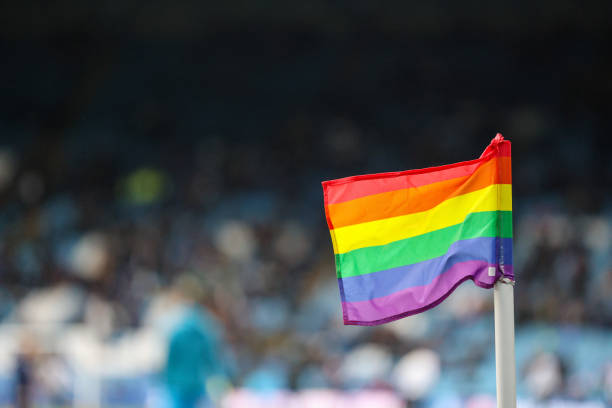
Sports have long been described as a unifying space, where people of various backgrounds, beliefs, and identities can come together to support a common goal. This “unifying” space, however, has not always been welcoming to the LGBTQ+ community. Homophobia and transphobia cause persistent issues across athletic communities at every level. Athlete Ally is a nonprofit that is working to combat these issues, their mission offers a useful example for understanding how advocacy and strategic communication can intersect in sports.
The Origin of Athlete Ally
Athlete Ally was founded by Hudson Taylor, a wrestler at the University of Maryland who was not gay himself but became increasingly aware of the harm caused by homophobic language and culture in sports. To stand in solidarity with the LGBTQ+ community, he began wearing an equality sticker on his wrestling headgear during competition. Though he faced criticism from teammates, the action drew national media attention and thousands of messages from parents and closeted athletes who felt encouraged by what he had done. That response made clear to Taylor that athletes had a unique platform, and the unique ability to shift the culture of their sport. Athlete Ally
What the Organization Does
Athlete Ally’s mission is to help every athlete act as an ally and ensure that every LGBTQ+ person is welcome and safe in sports. The organization pursues that mission in three main ways: education, policy, and athlete activism. Athlete Ally
On the education side, Athlete Ally conducts trainings on college campuses and with the front office staff of major sports leagues including the NBA, NCAA, and MLB, working to help athletic communities understand the obstacles LGBTQ+ people face and how to build more inclusive environments. The organization also works on proposing and changing existing policies to support their mission. Athlete Ally co-authored the NCAA’s first-ever policy and resource guide on LGBTQ issues for coaches, athletes, and administrators, and worked with the NBA, NCAA, and ACC on their decisions to move competitions out of North Carolina in response to the anti-LGBTQ law HB2. They also created the Principle 6 campaign, which successfully lobbied the International Olympic Committee to include sexual orientation in the Olympic Charter. Wikipedia, Athlete Ally
The Ambassador Program is at the center of the organization’s athlete activism work. Athlete Ally has attracted more than 250 professional athletes and Olympians, and has active chapters at more than 50 colleges and universities across the country. These ambassadors use their platforms to visibly champion inclusion within their own athletic communities, the same principle that motivated Taylor as a college wrestler, scaled across professional and collegiate sports. Idealist
The PR Angle
From a communications perspective, what makes Athlete Ally effective is that their strategy is built around credibility. Advocacy in sports can easily be dismissed as performative, particularly when it comes from organizations or brands rather than athletes themselves. By centering the voices and visibility of actual athletes, Athlete Ally avoids that skepticism. The organization’s belief is that athlete activism should be expected and accepted, and their communications reflect that, positioning athletes as genuine stakeholders with real investment in the outcome. Athlete Ally
Their corporate partnerships reinforce this. Adidas has been a presenting sponsor of Athlete Ally’s annual Athlete Activism Summit since 2022, contributing athlete speaker engagement and programming each year. The NWSL, NBA, WNBA, MLS, and USTA are among the league partners who support the organization’s work throughout the year. These relationships represent institutional buy-in from some of the most prominent organizations in professional sports, which strengthens Athlete Ally’s credibility and largely extends their reach. Sports Illustrated, Athlete Ally
Why It Matters
Earlier on this blog, I wrote about how the NHL leveraged the popularity of Heated Rivalry, a series that brought significant LGBTQ+ representation to a sport not traditionally associated with it. The audience engagement that followed was massive. Athlete Ally is working on the structural side of the same issue: not only capitalizing on cultural moments, but building the conditions that make sports genuinely welcoming for LGBTQ+ athletes and fans in the first place. The two are not separate conversations. They are part of the same shift in how sports organizations understand their relationship with a broader and more diverse public. For PR professionals working in this space, understanding that shift is an increasingly important part of the job.


Leave a Reply